
The Connection Between Lemoore and NAS Lemoore
In California’s Central Valley, the city of Lemoore has a distinctive relationship with one of the United States Navy’s most important aviation installations. Naval Air Station Lemoore, commonly known as NAS Lemoore, is not simply a military facility located near the city. It is a major institution that has influenced the development, employment base, housing market, business environment, transportation network, and community identity of the surrounding area for decades.
For residents who live in Lemoore and throughout Kings County, the presence of NAS Lemoore can be seen in many parts of everyday life. Military aircraft regularly operate from the installation, military families live in nearby neighborhoods, local businesses serve service members and civilian employees, and regional infrastructure must accommodate both civilian and military needs.
The relationship is particularly significant because Lemoore is located in an agricultural region rather than a major metropolitan area. When NAS Lemoore was established, the surrounding area was relatively rural and heavily agricultural. The Navy selected the location partly because it offered room for aviation operations and future development while remaining sufficiently distant from large population centers. The surrounding agricultural landscape continues to be an important characteristic of the region today. The U.S. Navy’s official NAS Lemoore history explains that the installation was commissioned in July 1961 and was built in an area where surrounding land was primarily used for agriculture.
More than six decades later, NAS Lemoore remains a major part of the local economy. Understanding its role helps explain why Lemoore has developed the way it has and why the installation continues to matter to Kings County.
A Brief History of NAS Lemoore
NAS Lemoore was commissioned in July 1961 during a period when the United States Navy was expanding and modernizing its jet aviation capabilities. The location in the San Joaquin Valley offered several advantages for military aviation. It was close enough to transportation and logistical networks while providing a relatively open environment for flight operations.
The original installation was designed around the needs of jet aircraft. Over time, the base evolved along with naval aviation technology. What began as a major facility for earlier generations of Navy fighter aircraft eventually became home to advanced F/A-18E/F Super Hornets and the F-35C Lightning II.
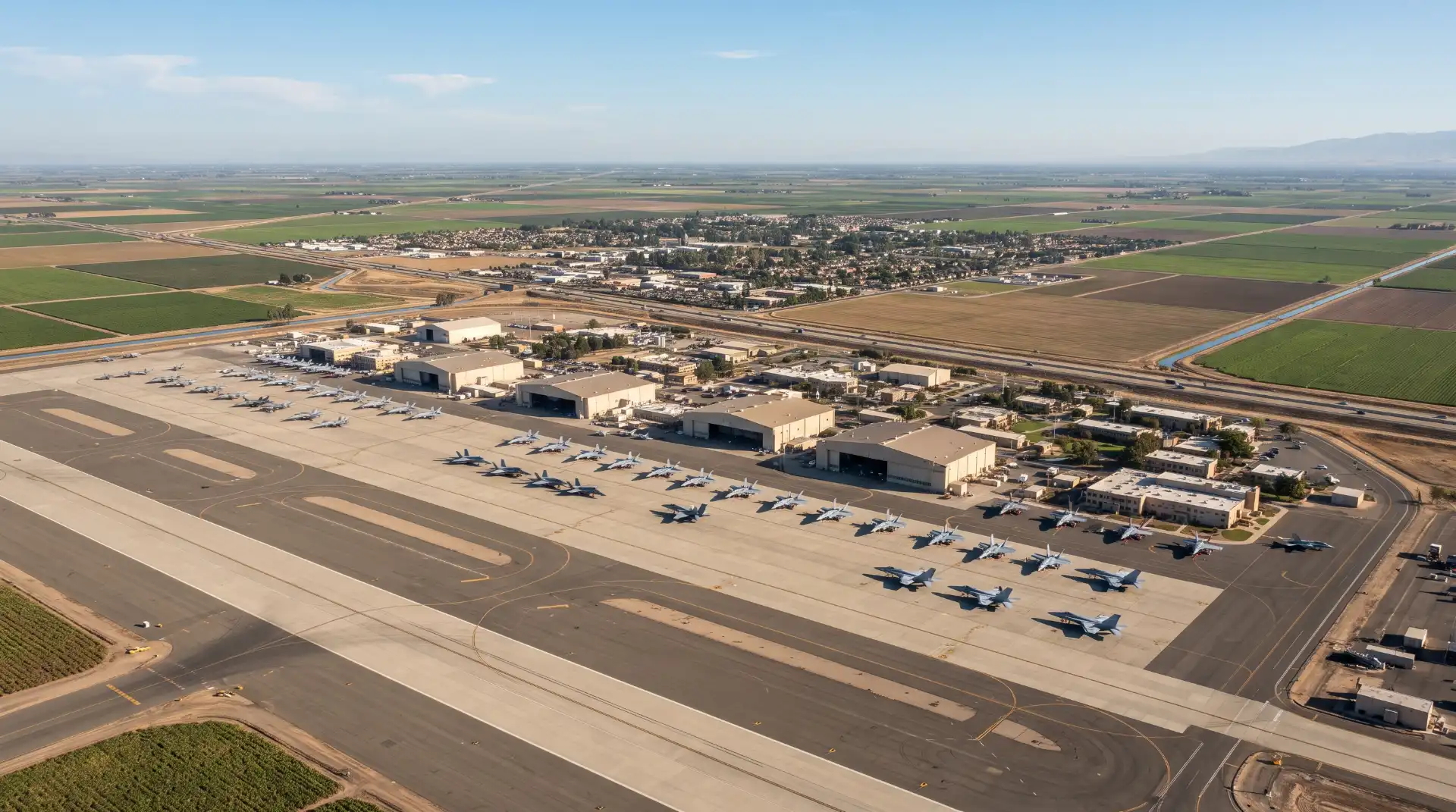
The Navy describes NAS Lemoore as its premier Master Jet Base and identifies it as the only Navy installation that houses the F-35C Lightning II. The installation is also home to Commander Strike Fighter Wing Pacific and Commander Joint Strike Fighter Wing. The current installation includes numerous operational and training squadrons and supports a very high volume of aviation activity.
This history matters economically because a major military installation tends to develop its own workforce, infrastructure, procurement needs, housing demand, and service requirements. As NAS Lemoore grew, the surrounding communities developed alongside it.
How Large Is NAS Lemoore Today?
The scale of NAS Lemoore helps explain why its influence extends beyond the boundaries of the installation.
The Navy currently reports more than 10,500 personnel associated with NAS Lemoore. The installation hosts 16 operational Strike Fighter squadrons, two Fleet Replacement squadrons, one Search and Rescue squadron, and four West Coast Carrier Air Wing commands and staffs. The Navy also reports an average of approximately 210,000 flight operations each year.
These numbers represent more than military activity. A workforce of this size requires housing, food, transportation, healthcare, childcare, retail services, recreation, financial services, vehicle maintenance, professional services, and many other forms of support.
Military installations also generate activity through contractors, suppliers, temporary personnel, visitors, construction projects, maintenance operations, and government spending. As a result, the economic relationship between NAS Lemoore and the surrounding area is broader than the number of people who receive a paycheck directly from the Navy.
NAS Lemoore as an Economic Anchor
One of the clearest ways to understand NAS Lemoore’s importance is to look at its economic impact.
The Navy states that in fiscal year 2019, NAS Lemoore generated approximately $947 million in economic benefit for Kings County and surrounding areas and provided almost 8,500 jobs. The Navy’s current Total Force Manpower page continues to identify this FY2019 economic figure when describing the installation’s regional contribution.
Because the published $947 million figure refers specifically to fiscal year 2019, it should not be interpreted as a current 2026 economic estimate. Economic conditions, payroll levels, contracting, inflation, and regional employment change over time. Nevertheless, the figure demonstrates the scale of NAS Lemoore’s economic footprint.
An earlier Navy economic impact assessment provides additional historical context. For fiscal year 2008, the Navy estimated that NAS Lemoore was associated with 12,142 jobs and approximately $717.5 million in labor income across the regional economy. That older analysis included military personnel, civilian employees, contractors, and jobs associated with base expenditures.
These historical numbers should be viewed as historical benchmarks rather than current economic measurements. Their importance is that they demonstrate how military spending can circulate through a regional economy instead of remaining entirely within the installation.
Military Employment Supports the Wider Community
Direct employment is one of the most visible economic connections between NAS Lemoore and the surrounding area.
Military personnel work in aviation, operations, administration, maintenance, logistics, security, communications, healthcare, training, engineering, and many other fields. The installation also employs civilian workers and relies on contractors for a wide range of services.
The Navy’s NAS Lemoore Human Resources Office identifies several employment categories associated with the installation, including civil service positions, Morale, Welfare and Recreation employment, Navy Exchange employment, and employment assistance for military family members.
Those employment opportunities matter beyond the individual employee. Workers spend their income in the surrounding community. They purchase groceries, fuel, clothing, meals, household goods, automotive services, entertainment, housing, and professional services.
For example, a service member who lives in Lemoore may rent an apartment, purchase gasoline locally, eat at a restaurant, take a vehicle to a local repair shop, shop at a grocery store, and participate in community activities. Each transaction connects the military payroll to a civilian business.
This circulation of money is one reason large installations can have significant regional economic effects.
Local Businesses Benefit From Military Families
The relationship between NAS Lemoore and Lemoore businesses is especially visible in everyday consumer activity.
Military families require many of the same products and services as other households. They shop for groceries, purchase household items, dine at restaurants, visit medical providers, maintain vehicles, use financial services, and spend money on recreation.
For local business owners, the military population can therefore represent an important customer base.
The effect can be especially noticeable in industries that serve households directly. Restaurants, automotive businesses, rental properties, home-service companies, childcare providers, retail stores, fitness facilities, entertainment businesses, and professional services can all interact with military-connected customers.
Some businesses may also benefit from the regular movement of military personnel. Service members can receive new assignments and arrive in Lemoore needing temporary lodging, transportation, household services, and housing. Other personnel eventually leave for new duty stations, creating a continuous cycle of relocation-related demand.
This turnover gives the local economy a characteristic that is somewhat different from communities where most residents remain in the same area for decades.
Housing Demand in Lemoore
Housing is another major connection between NAS Lemoore and the local economy.
Military personnel and their families need places to live. Some live within military housing or other facilities associated with the installation, while others live in Lemoore and surrounding communities.
When military families rent or purchase homes outside the installation, their housing decisions become part of the civilian economy. Rental properties, real estate professionals, mortgage providers, property managers, contractors, landscapers, plumbers, electricians, cleaning companies, and other home-service providers can all be connected to housing demand.
The Navy maintains family housing and bachelor housing resources at NAS Lemoore and provides housing-related assistance through the installation. The official NAS Lemoore phone directory also lists a Family Housing Office and housing-related services.
Housing demand, however, is influenced by many factors. Military assignments are only one component of the Lemoore housing market. Mortgage rates, local employment, new construction, household income, housing inventory, regional population changes, and California’s broader housing conditions can also affect prices and rents.
For that reason, it is more accurate to describe NAS Lemoore as an important contributor to housing demand rather than the sole force determining the local real estate market.
Military Families Become Part of the Community
The economic influence of NAS Lemoore is also closely connected to the families of service members.
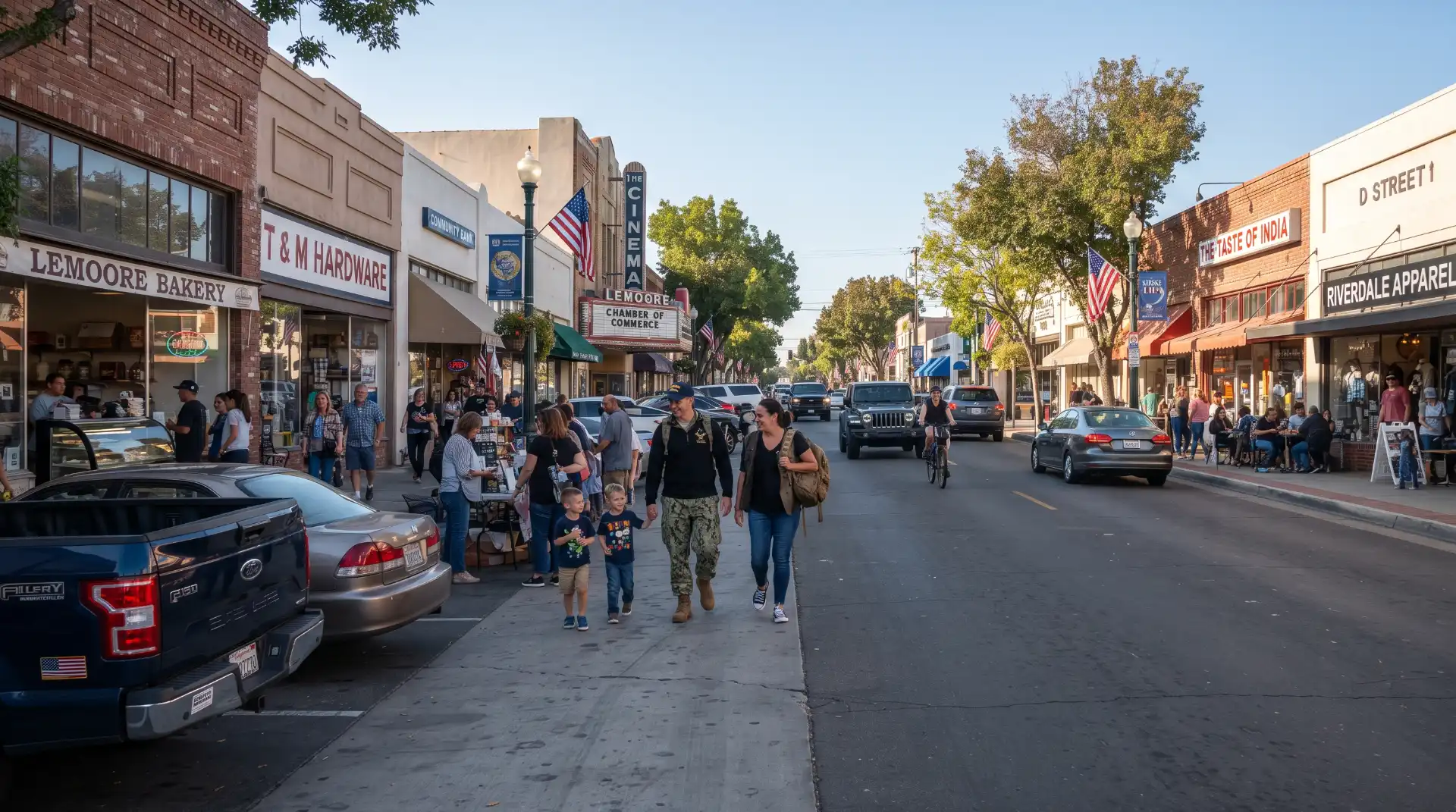
Military households participate in community life just like other families. Children attend schools, families visit parks, parents use childcare services, residents shop locally, and military spouses may seek employment or educational opportunities.
The Navy’s official directory lists local educational resources and a school liaison officer, as well as childcare and youth services connected with the installation.
When families become involved in local schools and community organizations, the relationship between NAS Lemoore and Lemoore becomes social as well as economic.
Military families can also bring new experiences and connections to the community. Service members arrive from different parts of the United States and, in some cases, from different backgrounds and regions of the world. Although military assignments may be temporary, some families develop long-term connections with Kings County even after leaving active duty.
Schools and Childcare Services
The presence of military families creates demand for educational and childcare services.
Families with young children may need daycare and early childhood programs. School-age children require elementary, middle, and high school services. Teenagers may participate in sports, extracurricular activities, employment, and community programs.
NAS Lemoore provides several family-support resources, including a Child Development Center, Child Development Homes, youth services, and a School Liaison Officer.
These services help military households manage the practical challenges of military life, including deployments, relocations, changing work schedules, and transitions between duty stations.
The broader community also benefits because military families interact with civilian educational and service providers throughout the region.
Healthcare and Professional Services
Healthcare is another area where the military presence affects the local service economy.
NAS Lemoore operates a Naval Health Clinic, while military families may also interact with healthcare providers in the surrounding civilian community depending on their healthcare arrangements and circumstances.
The installation’s official directory lists the Naval Health Clinic Lemoore, dental services, family support resources, and other health-related contacts.
A community with thousands of military personnel and family members requires a wide variety of professional services. Healthcare is only one example. Financial institutions, insurance providers, legal professionals, accountants, real estate professionals, educational organizations, and other service providers may also serve military-connected households.
This creates another layer of economic activity that may not be immediately visible when people think about the military base.
Transportation and Roads Connect Lemoore With NAS Lemoore
Transportation is essential to the relationship between the city and the installation.
NAS Lemoore is located along California State Route 198, with access to major regional highways. The Navy states that the installation is approximately 19 miles east of Interstate 5 and about 30 miles west of Highway 99.
Road access matters because military personnel, civilian workers, contractors, visitors, and families travel between the installation and surrounding communities every day.
Transportation also affects businesses. Employees need reliable routes to work, customers need access to stores, deliveries need to reach businesses, and military-related traffic must be accommodated alongside agricultural and civilian transportation.
As the region develops, transportation planning becomes an important part of maintaining a strong connection between NAS Lemoore and surrounding communities.
Why Agriculture and NAS Lemoore Coexist
Lemoore’s economy cannot be understood without considering agriculture.
Kings County is part of one of the most productive agricultural regions in the United States, and farms surround much of the area around NAS Lemoore.
Interestingly, agriculture and military aviation are closely connected to the history and current operation of the installation.
The Navy explains that the land surrounding NAS Lemoore was primarily agricultural when the location was selected. Today, agriculture remains present on the installation itself. The Navy’s environmental information states that nearly three-quarters of NAS Lemoore’s land area, approximately 11,500 acres, is leased to local farmers. The primary crops listed by the Navy include cotton, wheat, and sugar beets. The agricultural lease program produces between approximately $900,000 and $1.2 million in annual rents.
This is an unusual example of military land supporting agricultural activity while the installation simultaneously serves a major national defense mission.
It also demonstrates why land-use planning is particularly important in Kings County. Agricultural operations, residential development, roads, utilities, and military aviation all occupy the same broader regional environment.
NAS Lemoore and the Local Contractor Economy
Large federal installations require extensive supplies and services.
Maintenance, construction, infrastructure, technology, transportation, engineering, environmental services, equipment, professional consulting, and other activities can create opportunities for contractors.
Not every company serving NAS Lemoore needs to be located directly outside the base. Regional companies can participate in military-related procurement and services from communities throughout Kings and neighboring counties.
The installation therefore functions as part of a larger regional business network.
For small businesses, government contracting can represent a potential source of customers, although federal contracting involves specific requirements and competitive processes. Businesses interested in this area need to research current federal procurement rules and official contracting opportunities rather than assuming that proximity to NAS Lemoore guarantees business.
Retail, Restaurants and Everyday Spending
One of the simplest ways NAS Lemoore affects the local economy is through everyday consumer spending.
Military personnel and civilian employees need food during and after work. Families purchase household products. Residents need gasoline and vehicle maintenance. People go to restaurants, coffee shops, stores, gyms, entertainment venues, and community events.
The installation itself also provides numerous services and amenities, including a commissary, Navy Exchange, fitness centers, recreational programs, restaurants, bowling facilities, and other services.
Even when residents use on-base services, military personnel and families also spend money in the surrounding civilian community.
That creates a two-way relationship in which the installation provides services internally while nearby businesses serve the broader community.
Hotels and Visitors Add Another Economic Layer
NAS Lemoore also attracts people who do not permanently live in the city.
Military training, official business, family visits, temporary assignments, contractors, and other activities can bring visitors into the region.
Those visitors may need lodging, meals, fuel, transportation, and other services.
For a smaller community, even temporary increases in visitors can create additional business for hotels, restaurants, gas stations, convenience stores, and other local services.
The Navy has historically documented the presence of transient military and civilian personnel associated with training and temporary assignments. Older economic assessments found that these visitors contributed to regional spending.
Because those assessments are historical, they should not be treated as current visitor counts. Still, they illustrate how military training activity can create economic connections outside the installation.
F-35C Lightning II and the Future of NAS Lemoore
The introduction and continued operation of the F-35C Lightning II is an important part of NAS Lemoore’s modern identity.
The F-35C is the carrier variant of the F-35 family and is designed for operations from aircraft carriers. NAS Lemoore is the only Navy installation identified by the Navy as housing the F-35C.
Advanced aircraft require specialized personnel, infrastructure, maintenance, training, and logistical support.
This helps reinforce the strategic role of NAS Lemoore within U.S. naval aviation and contributes to the long-term importance of the installation to the surrounding region.
For Lemoore, that importance can translate into continued demand for housing, services, transportation, infrastructure, and workers associated with the installation.
Training Activity Brings Additional Economic Activity
NAS Lemoore is not simply a place where aircraft are stationed. Training is a central part of its mission.
The Navy reported in its 2022 anniversary material that more than 3,700 students were trained annually at the installation. The same Navy release reported more than 210,000 annual flight operations.
Training brings personnel into the region for temporary periods. Students, instructors, support personnel, visiting military units, and other participants can contribute to local demand for services.
Training also requires infrastructure and support workers, further connecting military operations with the regional economy.
Community Planning Is Important for Lemoore’s Future
Because military aviation and civilian development exist side by side, planning is an important issue for Lemoore and Kings County.
Residential development, commercial construction, agriculture, roads, utilities, schools, and other community projects must be considered alongside military aviation requirements.
NAS Lemoore maintains a Community Plans and Liaison Officer program that works with elected officials, planners, school boards, utilities, business organizations, and other community stakeholders. The Navy’s encroachment-management program addresses issues such as land-use compatibility and community planning.
This coordination helps reduce conflicts between civilian growth and the operational needs of the installation.
For example, development near an active military airfield can involve considerations related to aircraft operations, noise, safety, land use, and infrastructure. Local planning therefore has implications for both civilian residents and national defense operations.
Aircraft Noise Is Part of Life in the Lemoore Area
One of the most recognizable effects of NAS Lemoore is aircraft noise.
Residents in the surrounding area regularly hear military aircraft operating from the installation. The Navy itself refers to the aircraft activity as the “Sound of Freedom.”
For many residents, the sound is simply part of living near a major military aviation facility. For others, aircraft noise can be an important consideration when buying or renting property.
This is another reason compatible land-use planning matters. Residential and commercial development around an active airfield needs to consider the realities of aviation operations.
Why Local Businesses Should Understand the Military Community
For Lemoore business owners, understanding the military community can be useful even when a company does not directly work with NAS Lemoore.
Military customers can have different circumstances from other customers because assignments may be temporary, relocation can happen quickly, and households may include active-duty personnel, spouses, children, retirees, and veterans.
A business that provides clear information, flexible services, and convenient scheduling may be better positioned to serve customers whose lives are affected by military assignments.
Local businesses can also become part of the broader community network by participating in community events, supporting schools, working with local organizations, and maintaining relationships with both civilian and military residents.
NAS Lemoore’s Relationship With Veterans
The influence of NAS Lemoore does not necessarily end when service members leave active duty.
Some veterans remain in the Central Valley after completing their military service. Others return later in life, visit former colleagues, or maintain connections with the area.
Veterans can contribute to the local economy as homeowners, entrepreneurs, employees, community volunteers, and consumers.
The installation’s continuing role in naval aviation therefore contributes to a longer-term military connection that extends beyond active-duty assignments.
Economic Diversity Helps Strengthen Kings County
Although NAS Lemoore is economically important, it is only one component of the Kings County economy.
Agriculture remains fundamental to the region. Food processing, manufacturing, healthcare, education, retail, public services, transportation, and other industries also contribute to local employment and economic activity.
This diversity matters because communities are generally influenced by multiple economic sectors at the same time.
NAS Lemoore provides a major military and government component that exists alongside the region’s agricultural and civilian industries.
The combination gives Lemoore and Kings County an economic character that is different from either a purely agricultural community or a large metropolitan military city.
What NAS Lemoore Means for Lemoore Residents
For residents, the impact of NAS Lemoore can be understood through everyday experiences.
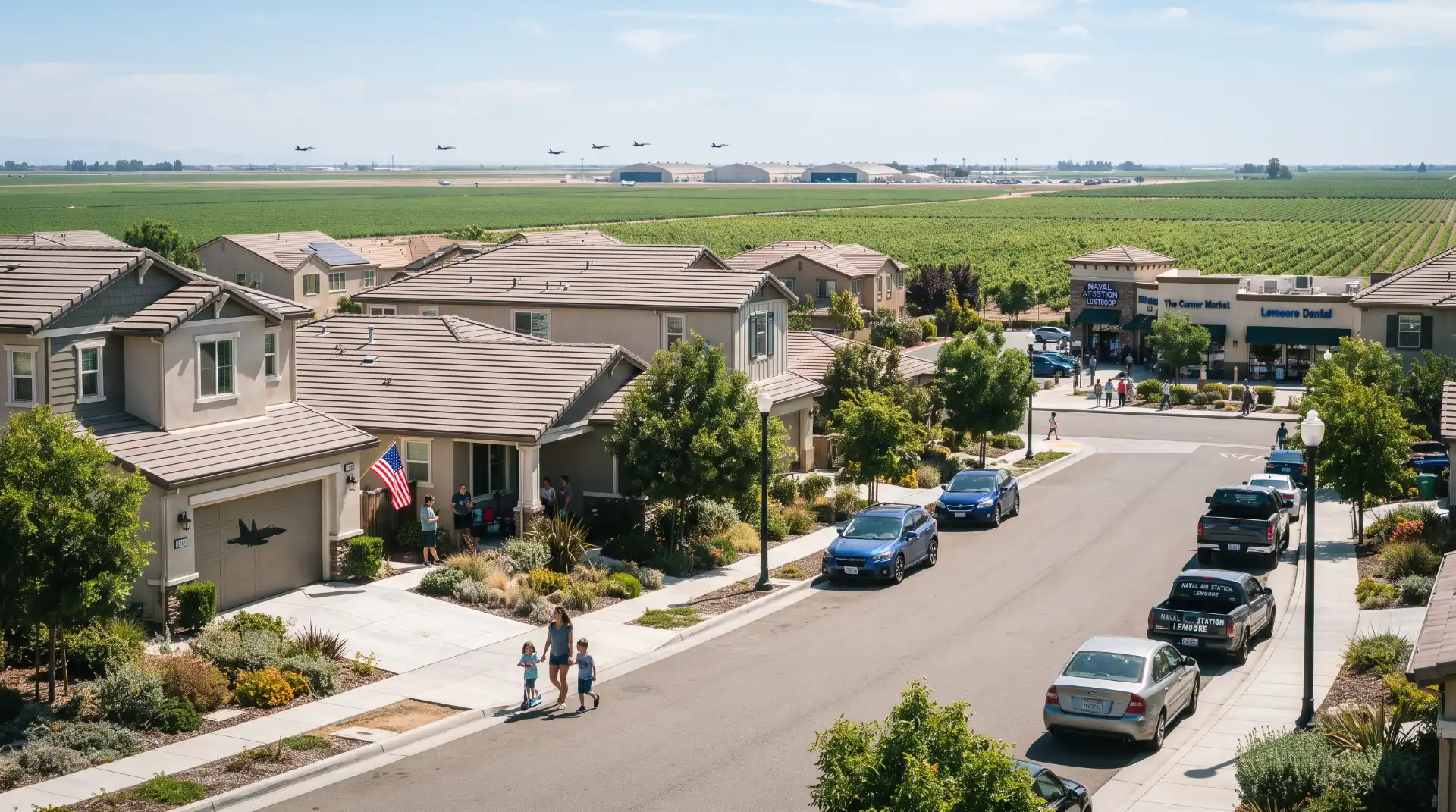
It can mean seeing fighter aircraft in the sky, encountering military families at local stores, hearing about base-related employment, seeing construction and infrastructure projects, and sharing community spaces with people stationed at the installation.
It can also mean economic opportunities for businesses and workers who serve the military community.
At the same time, living near a major military installation means residents need to understand that aviation operations are an established part of the community’s environment.
The relationship is therefore complex but highly visible.
The Future of Lemoore and NAS Lemoore
The future of Lemoore will continue to be influenced by the presence of NAS Lemoore, although the precise economic effects will change over time.
Military missions can evolve. Aircraft technology changes. Housing demand shifts. Transportation infrastructure develops. Local businesses open and close. Agricultural conditions change. Federal defense priorities can also influence military installations.
What is less likely to change quickly is the fundamental importance of NAS Lemoore as a major aviation installation within the Central Valley.
The Navy continues to describe NAS Lemoore as a major home for Navy strike-fighter aviation and reports more than 10,500 personnel associated with the installation.
As long as that mission remains significant, the installation will continue to have an important relationship with Lemoore and the wider Kings County economy.
Conclusion: A Military Installation With a Regional Economic Role
NAS Lemoore is an important part of the story of Lemoore, California.
Since its commissioning in 1961, the installation has grown from an early jet aviation base into a major center for modern Navy fighter aviation. Today, it supports thousands of military and civilian personnel, hosts advanced aircraft including the F-35C Lightning II, conducts a large volume of flight operations, and remains closely connected to the communities around it.
Its economic influence extends beyond military employment. Housing, restaurants, retail stores, transportation providers, contractors, healthcare providers, schools, childcare services, professional businesses, and other parts of the civilian economy interact with the military population.
The Navy’s published FY2019 estimate of approximately $947 million in economic benefit and almost 8,500 associated jobs illustrates the scale of the installation’s regional importance, although those figures should be understood as a historical economic benchmark rather than a current 2026 estimate.
The relationship is also distinctive because NAS Lemoore exists within a strongly agricultural landscape. The Navy currently reports that approximately 11,500 acres of installation land are leased to local farmers, demonstrating how military operations and agriculture coexist within the same broader region.
For Lemoore residents and businesses, NAS Lemoore is therefore more than a nearby federal facility. It is a major part of the area’s economic and community identity.
As Lemoore continues to grow and Kings County continues to evolve, the relationship between the city, the surrounding agricultural economy, and NAS Lemoore will remain an important part of understanding the region’s future.
Official Resource
For current information about installation services, contacts, employment resources, housing, community programs, and other official information, readers should consult the official Naval Air Station Lemoore website.